

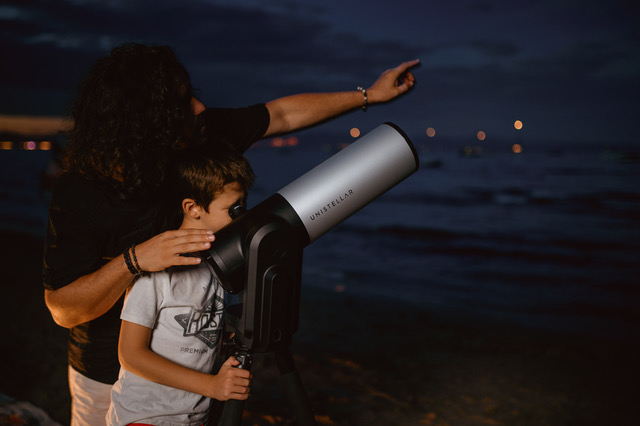
Unisteller eVscope2

10% off!
See the planetary alignment beautifully with the eVscope 2, which brings power and speed together with optical expertise to deliver the most immersive space exploration experience.
The eVscope 2 is an all-in-one smart telescope, controlled by an iOS or Android app: observe over 5,000 deep-sky objects in color, in detail, and in less than a minute!
On the evening of February 28, 2025, the night sky will throw a cosmic party—and all seven of the other planets in our Solar System will RSVP. That’s right: Saturn, Mercury, Neptune, Venus, Uranus, Jupiter, and Mars will all line up in a perfectly straight row, like a celestial conga line. This is what’s known as a great planetary alignment, and it’s about as rare as finding a unicorn doing the Macarena.
But wait, there’s more! Before that stellar soirée, on January 21, 2025, six of those seven planets will still show up to the party, just without Mercury. That’s Mars, Jupiter, Uranus, Neptune, Venus, and Saturn—basically the cool planets, leaving Mercury at home to sulk.
These seven-planet alignments are rarer than a solar eclipse on a leap year, so when it happens, you’ll want to mark your calendar and maybe even take the day off work. (Just kidding… unless you really want to.)
Now, before you start imagining the planets lining up in a perfect, orderly row like in your favorite astronomy diagram, let me burst your bubble: that’s not how it works in reality. The Universe isn’t that tidy. Instead, the planets will appear to line up along an invisible line because they all orbit the Sun on the same flat plane—sort of like how the grooves on a vinyl record stay mostly level. So no, they won’t all be holding hands, but it’ll still be an amazing sight!
How to Watch the Magic Unfold
Whether you’ll be able to see this planetary parade depends on where you live, so check your local listings. (Spoiler: “Space Channel” doesn’t exist… yet.)
To figure out the best time and place to catch the show, use tools like Time and Date’s interactive sky guide. You can set the date and find out when each planet will rise and set, plus how tricky they’ll be to spot. If you’re a tech geek, Stellarium is a stellar web tool (see what we did there?) that shows you planetary positions. Or, for the mobile fans, download Sky Tonight, an app that uses your phone’s hardware to help you pinpoint exactly where all the celestial action is.
Pro tip: You’ll probably need binoculars or a telescope to get a good look. So, if you don’t already have one, now might be the time to start begging your friends for an early birthday present, or stop by to see us about the incredible Unisteller eVscope2. And remember, clear skies are key—so cross your fingers and maybe do a rain dance if needed.
Happy stargazing!