

Apple’s fall updates revolve around one star – the M5 chip – now powering the 14-inch MacBook Pro, iPad Pro, and Vision Pro. Each gets faster, smarter, and slightly more future-ready. Availability begins October 22, with M5 versions of the iMac, Mac mini, and MacBook Air expected soon, and M5 Pro/Max chips arriving in early 2026.
The M5 Chip
Apple’s M5 focuses squarely on AI performance and speed.
- A 10-core GPU delivers up to 4× the peak graphics power of the M4 and 45% faster ray tracing.
- The 10-core CPU (4 performance + 6 efficiency cores) offers a 15% multithreaded boost.
- Unified memory bandwidth jumps from 120 GB/s → 153 GB/s, improving responsiveness across tasks.
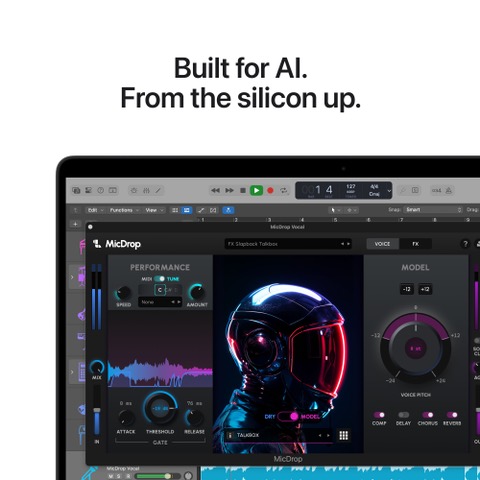
14-inch MacBook Pro
The entry-level MacBook Pro now packs M5 muscle. Apple claims 20–80% faster performance than M4 models and up to 7× faster than the M1 Pro.
Other highlights:
- SSD speeds doubled – likely matching last year’s M4 Pro and M4 Max models.
- Storage up to 4 TB (previously Pro-tier only).
- Same ports, screen, and design; starts at $1,599 (16 GB RAM / 512 GB SSD).
It’s now clearly faster than the M4 MacBook Air, though those seeking top-tier power will still prefer the M4 Pro or Max versions.
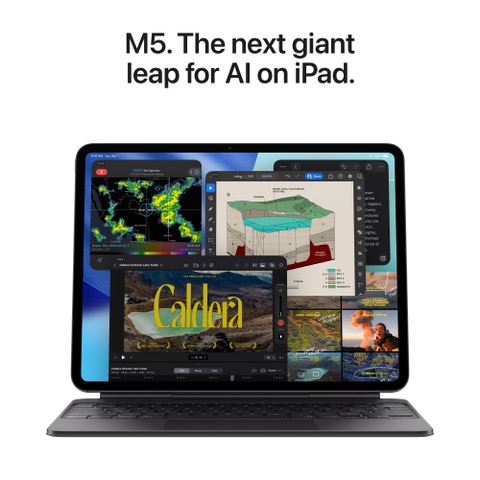
11- and 13-inch iPad Pro
The M5 iPads are twice as fast for AI image generation and 2.3x faster for video upscaling. Key changes:
- 2x faster storage (up to 2 TB).
- Unified memory bump: 12 GB on 256 and 512 GB models; 16 GB on 1 and 2 TB models.
- External 4K display @ 120 Hz Adaptive Sync which reduces latency and enhances gaming performance.
- 50% charge in 30 minutes (using appropriate charger)
- New C1X modem + N1 wireless chip bring Wi-Fi 7, Bluetooth 6, and Thread.
Design, cameras, and accessories remain unchanged. Pricing starts at $999 (11-inch) and $1,299 (13-inch).
Vision Pro
Apple’s “spatial computer” now runs on M5, boosting rendering and smoothness:
- 10% more pixels and a 120 Hz refresh rate reduce blur.
- Battery life +30 minutes (≈ 2.5 hrs use / 3 hrs video).
- New Dual Knit Band improves comfort.
Otherwise unchanged, including its $3,499 price tag, the upgrade refines rather than reinvents, keeping the Vision Pro a niche device.
Bottom Line
Apple’s M5 rollout is evolutionary, not revolutionary, but it shows where the company is heading: faster, more efficient chips tuned for on-device AI. Expect the rest of the Mac lineup to follow soon.